
How Fast You Eat Matters as Much as What You Eat
Here’s something most people never think about: you can eat the exact same meal—same ingredients, same calories, same macronutrients, same time of day—and get a completely different blood sugar response depending on one variable.
How fast you eat it.
It’s not always about what you eat. Sometimes it’s about how you eat. And for people managing diabetes, pre-diabetes, or metabolic health in general, this is one of the most overlooked strategies available—because it doesn’t require changing your diet at all.
We’ve All Learned to Eat Wrong
I’ll be the first to admit it. Every one of us who has been through medical school, residency, and fellowship has learned what I call maladaptive feeding behaviors. You never knew when you were going to get to eat. So if food was in front of you, you shoveled it down as fast as you could and moved on with your workday.
But it’s not just doctors. Modern life has trained most of us to eat this way. We eat at our desks, in our cars, between meetings, standing in front of the fridge. We treat meals like tasks to get through rather than processes the body needs time to handle.
The problem? The equipment you’ve been issued—your digestive system, your pancreas, your insulin response—is not designed to cope with that.
The Experiment: Try This With Your CGM
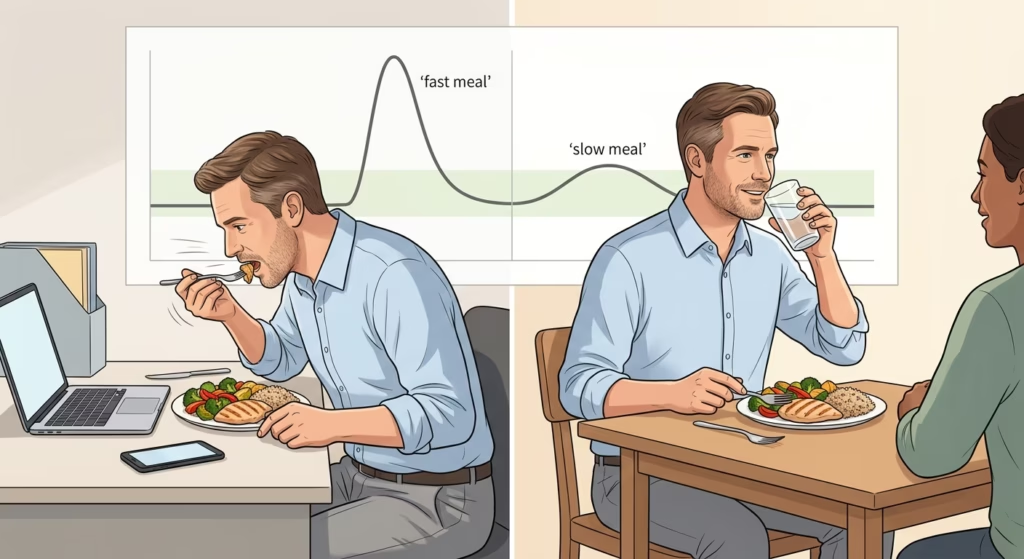
If you wear a continuous glucose monitor, this is one of the most interesting experiments you can do. Take one meal—identical in every way. Same macronutrients, same calorie load, same portion size, same time of day. Then eat it two different ways.
Scenario 1: The 5-Minute Meal
You eat the whole meal in five or six minutes. Maybe you’re at work, maybe you’re between errands, maybe it’s just habit. You barely chew, you don’t pause, and it’s gone before your body has had time to register what just happened.
What your CGM is likely to show: a large, rapid spike in glucose that may sustain for longer than you’d expect. The carbohydrates hit your bloodstream all at once, overwhelming your insulin response and creating a steep, dramatic curve.
Scenario 2: The 20-Minute Meal
You eat as if you’re a Parisian enjoying their cuisine. You set the fork down between bites. You drink water. You have a conversation. Maybe it takes 20 or 25 minutes to finish the same plate of food.
What your CGM is likely to show: a smaller rise on a slower slope, with a better correction as the meal concludes. The carbohydrates enter your bloodstream gradually, giving your pancreas time to respond proportionally. The result is a gentle rolling hill instead of a roller coaster.
Same meal. Same calories. Same macros. Two completely different glucose responses—just because of the speed you ate.
Why This Happens
When you eat quickly, you deliver a large bolus of carbohydrates to your digestive system in a very short window. Your small intestine absorbs glucose rapidly, and it floods into your bloodstream faster than your pancreas can respond with insulin. The result is a sharp spike, often followed by an overcompensation—your body floods insulin after the fact, which can cause a subsequent dip. That’s the roller coaster.
When you eat slowly, the carbohydrates enter your system in a more gradual, distributed way. Your pancreas has time to match insulin output to the incoming glucose in real time. The result is a flatter, more controlled curve—and your body doesn’t have to overreact to catch up.
This is one of the reasons why the same person can eat the same food and get wildly different numbers on different days. Speed is a hidden variable that most people never account for.
It’s Not Just Speed: Order and Pairing Matter Too
Eating speed is one of several “how you eat” strategies that can meaningfully change your glucose response without changing your diet. Here are a few others worth knowing:
Eat Vegetables First
Starting a meal with fiber-rich vegetables creates a buffer in your digestive system. The fiber slows the absorption of the carbohydrates that follow, resulting in a flatter glucose curve. It’s a simple reorder—salad or vegetables before the pasta, not after.
Never Eat “Naked” Carbs
A carbohydrate eaten alone—a piece of bread, a handful of crackers, a banana by itself—hits your bloodstream with nothing to slow it down. Pairing carbs with protein, fat, or fiber (what I call “dressing your carbs”) blunts the spike significantly. This is one of the most fundamental principles of glucose management, and it applies whether you have diabetes or not.
Save Sweets for Dessert
Something sweet eaten on an empty stomach—first thing in the morning or as a snack between meals—creates a much larger glucose spike than the same sweet eaten after a full meal. When your stomach already has protein, fat, and fiber in it, the sugar is absorbed more slowly. Dessert after dinner is metabolically smarter than a cookie at 3 p.m. on an empty stomach.
Move After Eating
Even a 10- to 15-minute walk after a meal can meaningfully reduce your glucose spike. Your muscles absorb glucose during activity, which takes pressure off your insulin response. It doesn’t need to be intense—a casual walk around the block is enough to make a measurable difference on your CGM.
A Strategy You Can Use Anywhere
Here’s what makes this so powerful: you can’t always control what you eat, but you can almost always control how you eat it.
At a business dinner where the menu is fixed? Slow down. At a family gathering where someone else cooked? Set the fork down between bites, drink water, take your time. Traveling and stuck with airport food? Eat it slowly rather than inhaling it at the gate.
This isn’t about restriction. It’s not about elimination. It’s not about guilt. It’s about giving your body the time it needs to process what you’re giving it. These are additive strategies—small adjustments that layer into your existing life and create measurable improvements over time.
You don’t have to change what’s on your plate. Just change the pace at which you eat it.
Try the Experiment Yourself
If you wear a CGM—or if you’re considering one—this is one of the first experiments I’d encourage you to try. Pick a meal you eat regularly. Eat it quickly one day and slowly the next, keeping everything else identical. Then compare the curves.
You’ll likely be surprised by the difference. And once you see it with your own eyes on your own data, it becomes hard to unsee. That’s the beauty of wearing tech that gives you instant biofeedback about what’s happening inside your body—it turns abstract advice into something personal and concrete.
Lifestyle is the cornerstone of success in both diabetes and obesity management. And sometimes the most impactful changes aren’t about overhauling your diet. They’re about making small, sustainable shifts in how you eat—and giving your body the respect of time.
Ready for Comprehensive, Root-Cause Care?
Now seeing patients in 7 states via telehealth: TX | CA | CO | OR | WA | OK | NM
Get your consultation in weeks—not 6 or 12 months.
469-THYROID (469-849-7643) | 817-380-4880
aidendo.com