

You can fill in a form online and have a prescription in your inbox fifteen minutes later.
Nobody examined you. Nobody ran a laboratory test. Nobody asked what else you take.
Here is what should happen instead, and why it is not just a matter of being thorough. Some of it decides whether your insurance pays.
Why does the diagnosis decide whether insurance covers it?
Because there is a genuine art to finding the right diagnosis when you want insurance to pay for medical therapy or for bariatric surgery.
We check your A1c, because if you have prediabetes or diabetes it makes the job of getting medication covered much easier. We check for certain cholesterol disorders, for the same reason, and because they tell us what cardiovascular testing to pursue next, such as a coronary calcium score. Heart disease is still our number one killer.
We screen for fatty liver disease, which has been exploding over the last decade or two and can be completely silent right up until someone needs a liver transplant. Some medications are approved to treat it, which again affects coverage.
This is not paperwork. Finding the real diagnosis is often what makes treatment affordable.
Weight is a linchpin condition. Treat it properly and a lot of other things improve.
Why sleep apnea matters more than people think
Sleep apnea will interfere with your ability to lose weight, and the mechanism is not the one most people assume.
Every time you stop breathing, your brain has to wake you up. But the part of the brain doing that is very sensitive and not very smart, so it cannot tell the difference between you snoring safely in your own bed and not getting quite enough oxygen, and you being chased by a predator.
Either way it has one job, which is to wake you up so you breathe. And the way it does that is with a surge of cortisol and a surge of adrenaline.
If that is happening fifty times an hour, every night, for years, that is an enormous amount of cortisol tone. And wherever your cortisol goes, your blood sugar follows. Your weight follows. Your blood pressure, your cholesterol and your bone loss all go up with it.
What else we look for
Thyroid function, because hypothyroidism will interfere with your ability to lose weight.
The perimenopause transition, which is a genuinely sticky period for metabolic change.
Cushing syndrome, which is rare but worth finding. It is a condition where the body cannot regulate how much cortisol it makes, often because of a small tumour that is ignoring every signal to stop. If you have it, losing weight is like trying to run uphill on a sheet of black ice. We screen for it with a dexamethasone suppression test, and if we find it and remove the source, everything else gets better.
Then the ordinary things that nobody seems to measure any more: blood pressure, waist circumference, waist-to-hip ratio, neck circumference.
Weight is a linchpin condition
We do not just follow the scale down. We follow all of it, because treating weight properly pulls a lot of other things with it.
Sleep quality improves. Joint pain improves, so you become more active, so you burn more and build more muscle, and it feeds on itself. Diabetes improves. Cholesterol improves. We start peeling blood pressure medications off.
That is what comprehensive weight management actually means, and it is why the fifteen minute version is not the same product.
What we keep checking once you have started
What we monitor depends on what we found at the beginning. If there was fatty liver, a cholesterol problem, a high A1c or a cortisol issue, we keep surveillance on those to be sure we are actually correcting them.
One that catches people out: if you are hypothyroid and on levothyroxine and you lose a significant amount of weight, your thyroid requirement changes. You will need less. That dose has to be rechecked, particularly if you have also been losing muscle.
Going through menopause during weight loss changes how hormones bind to proteins, which can change what other doses need to be.
And after bariatric surgery there is malabsorption, so bariatric vitamins are not optional and B12 and vitamin D need watching. Those deficiencies are not something you would notice day to day.
Frequently asked questions
Mark up as FAQPage schema. Each question is phrased the way a patient asks it out loud, and every answer opens with the direct response in the first sentence so it extracts cleanly.
What labs should be done before starting a weight loss medication?
At minimum: A1c, a cholesterol panel, screening for fatty liver disease, thyroid function, and an assessment for sleep apnea. Depending on the picture, that extends to a coronary calcium score and to screening for Cushing syndrome with a dexamethasone suppression test.
Why does my diagnosis affect whether insurance covers weight loss treatment?
Because coverage often depends on documented conditions rather than weight alone. Prediabetes, diabetes and certain cholesterol disorders make medication coverage substantially easier, and some drugs are approved for fatty liver, which opens another route.
Can sleep apnea stop you losing weight?
Yes. Each time you stop breathing your brain triggers a cortisol and adrenaline surge to wake you. Repeated fifty times an hour for years, that cortisol load raises blood sugar, weight, blood pressure and bone loss, and it works directly against weight loss.
Does my thyroid medication dose change if I lose weight?
Often yes. If you are on levothyroxine and lose a significant amount of weight, your thyroid requirement drops and the dose needs rechecking, especially if you have also lost muscle mass.
What is wrong with getting a prescription from an online form?
Nobody has assessed the things that determine whether the medication is safe or appropriate for you: interactions with what you already take, a history of pancreatitis or gastroparesis, a family history of certain thyroid cancers, and whether an underlying condition is driving the weight in the first place.
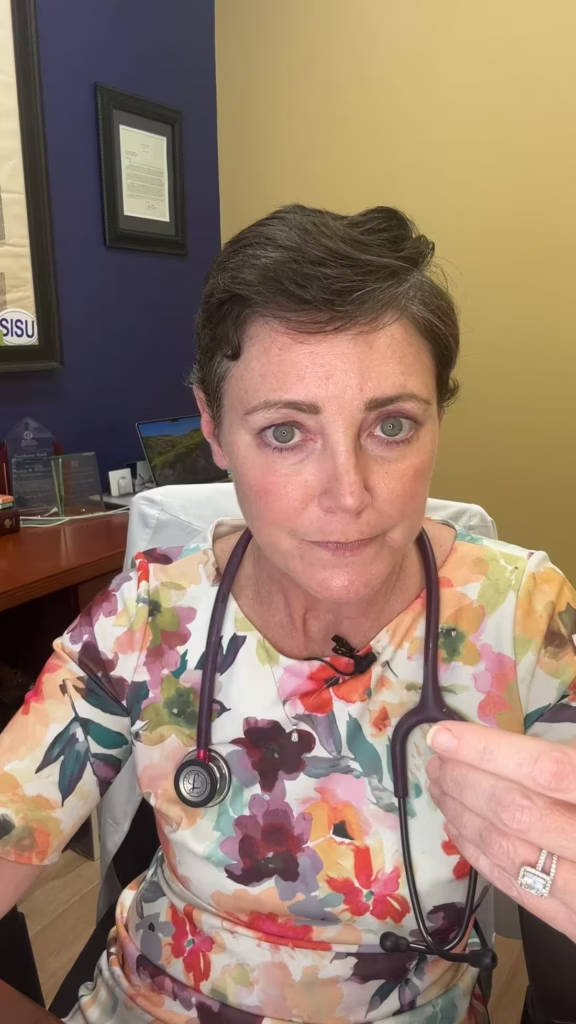
Dr. Lindsey M. VanDyke, DO, FACOI, FEAA, is dual board-certified in internal medicine and in endocrinology, diabetes and metabolism. She founded the Advanced Institute for Diabetes and Endocrinology in Mansfield, Texas, where new patients are typically seen within two weeks, with telehealth across seven states: Texas, Oklahoma, Colorado, Washington, California, New Mexico and Oregon.
This article is educational and is not medical advice. Treatment decisions, laboratory workups and medication changes must be made individually with your own physician.