
By Lindsey VanDyke, DO, Board Certified in Internal Medicine and Endocrinology
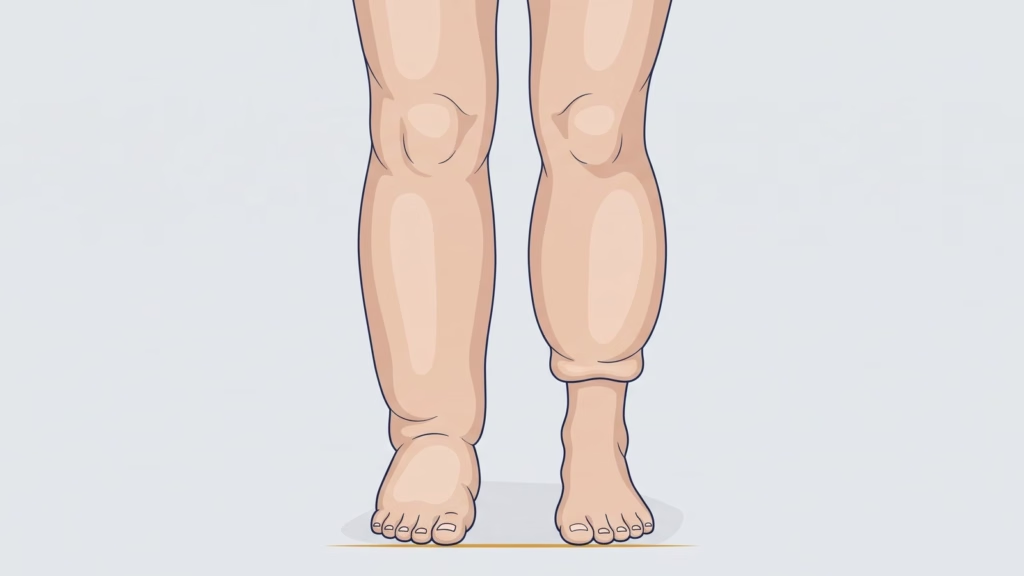
Would you recognize this? Legs that do not match the rest of the body. Hips, thighs and lower legs enlarged on both sides, tissue that hurts when you press on it, and below all of that, a foot that looks completely normal.
That is lipedema. Not lymphedema. Lipedema is its own process, and it gets confused with lymphedema because it looks like swelling. It is not just swelling. It also gets filed as garden variety obesity, sometimes for years.
Here is what lipedema looks like, the exam sign that separates it from the other causes, the three stages, and who actually treats it. The full video is on YouTube: “Is it lipedema or just your legs? The ankle sign to check”. The short versions are on Instagram and Facebook.
Key takeaways
- Lipedema is its own process. It is not lymphedema and it is not obesity, and it is frequently confused with both.
- Lymphedema is fluid buildup, puffy, with fluid cords. Lipedema is symmetric enlargement of the buttocks, hips, thighs and lower legs, sometimes the arms, and it is painful to press on.
- The cuff sign: enlarged fat pads around the ankle bones with a normal foot. Foot sparing, and hand sparing when the arms are involved.
- Lipedema hurts even when you are sitting still. It is only really found in women, it is progressive, and there is usually a family trend.
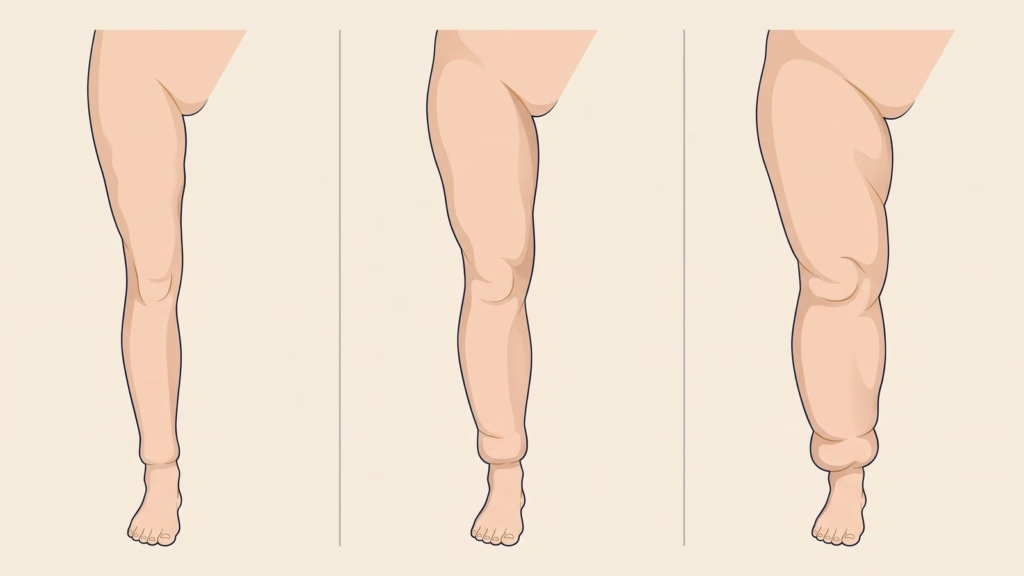
- Three stages are described. Early, the cuff sign and coarse tissue. By stage three, the leg shape is completely deformed.
- Manual lymphedema therapy does not make lipedema better. A specialized surgeon treats it by reducing the bulk of the fatty fibrous tissue.
What is the difference between lipedema and lymphedema?
Lymphedema is fluid buildup, mostly in the legs, sometimes in the arms. It is puffy, and you can feel the fluid cords. Lipedema is not fluid. It is symmetric enlargement of fatty fibrous tissue in the legs and sometimes the arms, it is painful to press on, and it spares the feet and the hands.
Anyone who has had lymph nodes removed after breast cancer knows what lymphedema feels like. And lymphedema usually has a story we can point to: a surgery, an infection, a vascular problem in that area. Something we can either resolve or at least treat.
Lipedema does not come with that story. It’s its own process. It is only really found in women, and it is progressive. It does not behave like fluid and it does not respond like fluid, which is the whole reason it matters to tell the two apart.
The 2021 US Standard of Care for lipedema, a Delphi consensus guideline published in Phlebology, reports the same split under the skin: dermal thickness “was normal in people with lipedema” while in lymphedema “dermal thickness was increased and fluid was present in the loose connective tissue” (Herbst et al., Phlebology 2021).
If you have been told it is swelling, or told it is weight, and neither explanation fits what you see in the mirror, that is the question we take in your first hour here. New patients are seen within about two weeks. Call or text (817) 380-4880.
What are the symptoms of lipedema, and who gets it?
Classically, lipedema shows up in fairly young women as symmetric enlargement of the legs: the buttocks, the hips, the thighs, the lower legs. It can happen in the arms. The tissue is painful to push on, and it hurts even when you are just sitting there. It usually runs in families.
This is not swelling that squishes down when you push on it. The tissue is painful to the touch, and the pain is there at rest. Other things hurt when you are walking or climbing stairs.
“This will be painful when you’re just sitting there.” (from the video)
Two more details. These areas do not tend to get skin infections. And lipedema is usually not something that happens at random to one person. There is usually a family trend.
As you would expect, it is psychosocially pretty distressing. The legs are visibly different from the rest of the body, they hurt, and nobody has given them a name.
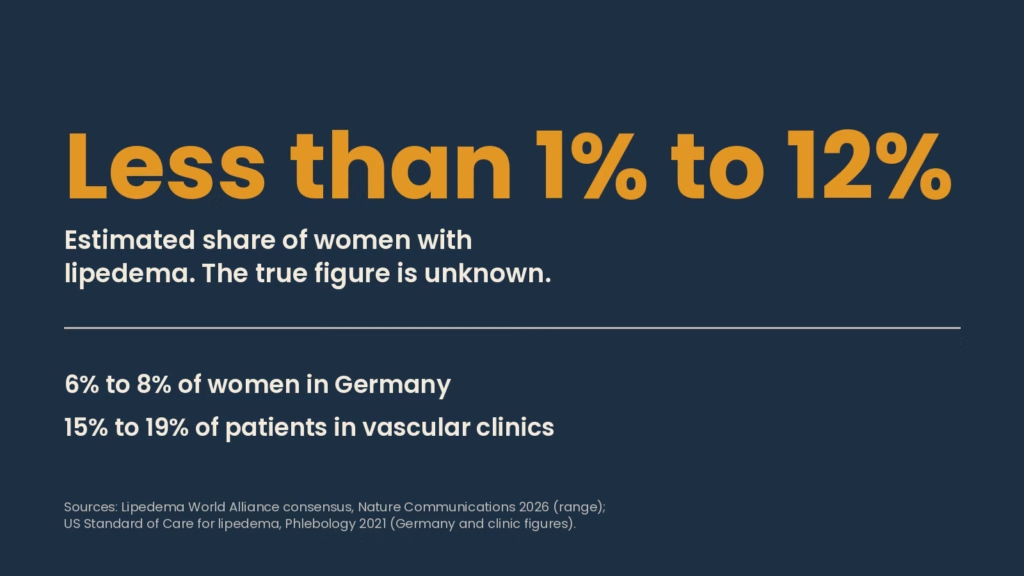
The Lipedema World Alliance’s 2026 consensus statement says “lipedema primarily affects biological females” and that prevalence “estimates range from less than 1% to up to 12%” (Kruppa et al., Nature Communications 2026), which is why I do not treat it as rare in my own exam room.
What is the cuff sign, and how do I check for it?
The cuff sign is a physical exam finding in lipedema. The fat pads around the ankle bones are enlarged, but the foot is normal. The tissue stops at the ankle like the cuff of your pants. That is foot sparing. When the upper arms are involved, the same thing happens at the wrist: hand sparing.
The US Standard of Care guideline notes that “a tissue cuff at the ankle or wrist may be present in all stages” (Herbst et al., Phlebology 2021), and the Lipedema World Alliance consensus statement puts the sparing in one line: lipedema “typically spares hands and feet of excess fat deposition” (Kruppa et al., Nature Communications 2026).
What are the three stages of lipedema?
Three stages of lipedema are described.
If you look at diagrams of lipedema, you can see the progression. Early on, the band at the ankles shows first and the tissue already has a coarse quality. In the middle stage that coarseness “really kind of blows up.” It expands and intensifies. By stage three, the leg has lost its shape entirely. This is a progressive condition, which is why the early cuff sign is worth recognizing for what it is rather than waiting to see what it becomes.
The US Standard of Care guideline describes the same progression by feel: stage 1 skin “has a smooth texture with subdermal pebble-like feel”, stage 2 adds “skin dimpling due to progressed fibrotic changes and excess tissue”, and stage 3 brings “numerous large subdermal nodules” with overhanging lobules of tissue (Herbst et al., Phlebology 2021).
Pain at rest, a cuff at the ankle and a normal foot are findings I can see in the room. A new consultation is an hour, long enough to look properly. Call or text (817) 380-4880, or book online.
Why does lipedema get misdiagnosed as obesity or lymphedema?
Historically, lipedema was simply misdiagnosed. “Oh, it’s just obesity.” Or “oh, it’s just lymphedema,” and the patient is sent to a lymphedema clinic for manual therapy. But it does not get better, because it is not lymphedema. And there are not a whole lot of people in the country who actually deal with lipedema.
The two wrong files are obesity and lymphedema. In the first, the legs get filed as weight, and the fact that they do not match the rest of the body, and that they hurt, never gets examined. In the second, the plan is manual therapy for swelling that is not swelling.
“It doesn’t get better. It’s not like lymphedema.” (from the video)
Hold on to that sentence if you have done the therapy and nothing changed.
The US Standard of Care guideline says it without softening, “under-recognition or misdiagnosis can delay identification of lipedema for decades” (Herbst et al., Phlebology 2021), and the Lipedema World Alliance consensus statement adds that “there is no evidence supporting the sole use of MLD for therapeutic benefits in lipedema”, MLD being manual lymphatic drainage (Kruppa et al., Nature Communications 2026).
Who treats lipedema, and what does an endocrinologist do?
Lipedema is treated by a specialized surgeon, because the goal of treatment is to reduce the bulk of the fatty fibrous tissue so people can have an improved quality of life. The endocrinologist’s part is recognizing it, telling it apart from lymphedema and from obesity, and getting you to the right person.
Please note that lipedema is outside my scope of practice. I do not treat it, and I am not a lipedema specialist. What I can do is recognize the signs on examination and refer you to a specialist who treats it.
This is not as clear cut as lymphedema, where we can attribute the swelling to an episode of something and either resolve it or treat it. “It’s much tougher to deal with lipedema.” The people who take it on are surgeons.
The US Standard of Care guideline states that “lipedema reduction surgery is currently the only available technique for removing abnormal lipedema tissue” and that it “significantly improves symptoms, mobility, stance, gait” and quality of life (Herbst et al., Phlebology 2021).
What I can do is look. If your legs do not match the rest of your body and nobody has given you a name for it, that is a visit. I examine the legs and the ankles, I ask about pain at rest and about family, and I tell you plainly whether what I am seeing is lipedema, lymphedema or something else. You do not need a referral to be seen here.
Where this leaves you
Lipedema is its own process. Fairly young women, symmetric enlargement of the legs and sometimes the arms. Painful to press, painful at rest. A cuff at the ankle and a normal foot. A family trend. Three stages, progressive. Lymphedema therapy does not fix it, and a specialized surgeon treats it. The first step is a name, and the name comes from an exam.
The US Standard of Care guideline describes lipedema as “a loose connective tissue disease predominantly in women” that “develops at times of hormone, weight and shape change including puberty, pregnancy, and menopause” (Herbst et al., Phlebology 2021), which is the family and timing history I ask about.
Bring the legs that do not match. We examine them, tell you what we see, and if it is lipedema we say so and point you to the surgeon who treats it. In person in Mansfield for Dallas Fort Worth, or by video in Texas, Oklahoma, New Mexico, Colorado, California, Oregon and Washington. Call or text (817) 380-4880, or book online.
Frequently asked questions
What is the difference between lipedema and lymphedema?
Lymphedema is fluid buildup that feels puffy, with fluid cords you can feel, often after lymph nodes are removed. Lipedema is symmetric enlargement of fatty fibrous tissue in the legs and sometimes the arms. It is painful to press on, it spares the feet and the hands, and it does not behave like fluid.
What is the cuff sign in lipedema?
The cuff sign is enlarged fat pads around the ankle bones with a foot that is normal below them. The tissue stops at the ankle like a cuff. This is called foot sparing. When the upper arms are involved there is hand sparing as well. It is one of the earliest signs of lipedema.
Does lipedema hurt?
Yes. Lipedema tissue is typically painful to push on, and it hurts even when you are just sitting there, not only when you are walking or climbing. Pain at rest is one of the features that separates lipedema from swelling that squishes down when pressed and from the other things it gets mistaken for.
What are the stages of lipedema?
Three stages are described. In the early stage the cuff sign appears at the ankles and the tissue is coarse. In the next stage the coarseness expands and intensifies. By stage three the leg shape is completely deformed, and in severe stage three, sometimes called 3B, you can barely distinguish the leg at all.
Does lymphedema therapy help lipedema?
No. Lipedema is not lymphedema, so sending someone to a lymphedema clinic for manual therapy does not make it better. Historically that was a common outcome, along with being told it was just obesity. Treatment is through a specialized surgeon who reduces the bulk of the fatty fibrous tissue.
Who treats lipedema?
A specialized surgeon treats lipedema, with the goal of reducing the bulk of the fatty fibrous tissue and improving quality of life. There are not many of them in the country. An endocrinologist’s role is to recognize lipedema, tell it apart from lymphedema and obesity, and send you to the right surgeon.
Related reading
- When a referral to an endocrinologist is worth asking for
- All time high weight: what an endocrinologist looks at first
- What we check before anyone gets a weight loss prescription
- Your first visit to the Advanced Institute for Diabetes and Endocrinology
If your legs have never matched the rest of you and every explanation so far has been swelling or weight, let me look at the ankles. Here is what the first visit looks like. Call or text (817) 380-4880.
Watch the full video. Is it lipedema or just your legs? The ankle sign to check
Last updated: 10 November 2026.
This article is general education, not medical advice. It does not create a physician and patient relationship. Talk to your own physician about your situation.
Dr. Lindsey M. VanDyke, DO, FACOI, FEAA, is dual board certified in internal medicine and in endocrinology, diabetes and metabolism. She founded the Advanced Institute for Diabetes and Endocrinology in Mansfield, Texas, where new patients are typically seen within about two weeks and a new consultation is an hour.
In person in Mansfield, or by video in Texas, Oklahoma, New Mexico, Colorado, California, Oregon and Washington.
Book your consultation. Call or text (817) 380-4880, or book online.