

By Lindsey VanDyke, DO, Board Certified in Internal Medicine and Endocrinology
Your face has gone round and puffy, your cheeks are red, and your feed says cortisol is the reason. TikTok is full of it right now.
The internet calls it cortisol face. The medical term is moon facies, and it is one classic sign of Cushing’s syndrome, excess cortisol driven by a tumor in the adrenal or pituitary gland. That is a real, but rare, disease, and most round faces are something else.
I open my video on this by holding up the textbook picture and asking, “Would you recognize this?” Here is how we tell a trend from a disease.
What is cortisol face, and is it a real diagnosis?
Cortisol face is an internet label, not a medical diagnosis, for a round, swollen face that people online blame on high cortisol, the stress hormone. The look alone does not tell you what is causing it.
In the video I say it this way:
“It’s not the only thing that can cause this kind of change in shape to the face. And so it’s important that these patients who notice these symptoms get screened for excess cortisol. But it’s not always that.” (from the video)
The label names the cause before anyone has checked for it.
What else makes a face look like that?
A steroid medication can round a face exactly the way Cushing’s does, and so can supplements that contain animal adrenal gland, which you may be taking without knowing it.
Other drugs with glucocorticoid activity do it too, including some progestogens. The Endocrine Society guideline calls prescribed corticosteroids the most common cause of Cushing’s syndrome, so I start with every pill and supplement you take.
Then there is pseudo-Cushing’s, the look without the biochemistry. Central obesity does it, especially when fat extends into the neck and face. So do badly controlled diabetes, chronic alcohol use, depression, polycystic ovary syndrome and eating disorders, which lightly switch on the stress axis. Weight gain that does not answer to effort still deserves a diagnosis, just not this one.
What are the signs of Cushing’s syndrome, and how rare is it?
The textbook signs are a round, swollen face with red cheeks, a fat pad on the upper back, weight gain centered on the abdomen with thinning legs, purple stretch marks, easy bruising and weakness getting up out of a chair.
You cannot see some of it: high blood pressure, high blood sugar, bone loss. People on a course of high dose steroids for any reason might feel like they’re crazy, and this condition does it for months on end. If a pituitary tumor presses on the optic nerves, add headaches and tunnel vision.
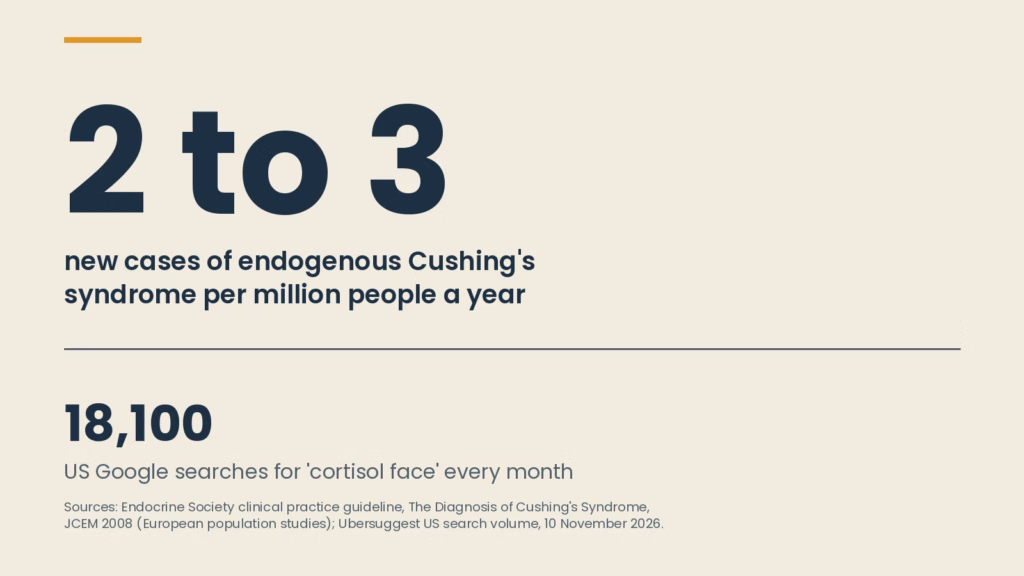
It is rare. The Endocrine Society’s 2008 guideline cites 2 to 3 cases per million people a year in European population studies, and NIDDK puts endogenous Cushing’s syndrome at about 40 to 70 people per million.
Which test diagnoses Cushing’s syndrome?
The most sensitive screening test for excess cortisol is the dexamethasone suppression test, a dynamic test, not a single morning cortisol. A positive result is confirmed with midnight saliva cortisol and 24-hour urine free cortisol before anyone orders a scan.
So at your appointment, ask for the dexamethasone suppression test by name.
Why does Cushing’s get missed or misread?
A morning cortisol feels like the smoking gun, but it does not diagnose excess cortisol. In a true case it can read upper normal while a tumor runs the adrenal glands flat out.
Very few primary care doctors are interested in doing the dexamethasone test. The other trap is saliva tests taken all through the day and read like a horoscope. Low at midnight, so it is impossible that I have this. High in the morning, so obviously I have excess. Neither conclusion holds. The saliva test that matters is at midnight, when your cortisol system should be off and the level undetectable. The same discipline applies to adrenal fatigue claims.
What does a real case of Cushing’s disease look like?
One patient was 21, eating salads at the college cafeteria and gaining anyway: 35 pounds in two and a half months. She had a moon face, purple striae, blood pressure of 155 over 92, an A1c of 6.3 and tunnel vision.
Her midnight saliva cortisol was high three nights running and her 24-hour urine free cortisol was positive. Her ACTH was on when it should have been shut off, her DHEA-S was high, and her morning cortisol read upper normal. That put the source in the pituitary, and the MRI showed a large tumor pressing on the optic nerves, which cross right over that gland like a coat draped over a chair.
A neurosurgeon removed it through the nose with a tiny scope. To get all of it, the whole pituitary had to come out, which caused panhypopituitarism. We replace what the gland can no longer ask for: thyroid hormone, hydrocortisone, estradiol and desmopressin.
Her before and after pictures are striking. She is also the exception, which is why I say in the video:
“We always have to do a full kind of workup to consider all the possible sources of this.” (from the video)
The takeaway
A screenshot cannot tell you why your face changed, and a morning cortisol cannot rule Cushing’s in or out. Bring your full medication and supplement list, photographs of your face from before and any lab work you already have, and ask which test was used to screen for Cushing’s. If the first test comes back abnormal, or you have striae, bruising, weakness or vision change, that is the moment to see an endocrinologist.
Frequently asked questions
Can my primary care doctor start the workup?
Yes. A primary care office can start it. Move on to an endocrinologist if the first test is abnormal or the picture includes striae, bruising, proximal weakness, new high blood pressure or vision change.
Who gets Cushing’s syndrome, men or women?
About three times as many women as men, according to NIDDK.
Should everyone with a puffy round face be screened?
Anyone who notices this change in the shape of their face should be screened, and most will not have Cushing’s. The screen rules a tumor in or out, then we look for the real cause.
What happens after surgery for Cushing’s disease?
If the whole pituitary comes out, the gland can no longer be asked for hormones, so we replace thyroid hormone, hydrocortisone, estradiol and desmopressin.
Watch the full video. “Cortisol face” is a trend. Cushing’s is a disease.
Want someone to actually look? Book a visit with the Advanced Institute for Diabetes and Endocrinology: in person in Mansfield, Texas, for Dallas Fort Worth, or by video in Texas, Oklahoma, New Mexico, Colorado, California, Oregon and Washington. Call or text (817) 380-4880, or book at aidendo.com/contact.
Drop your questions in the YouTube comments. We read every one.
Last updated 16 November 2026. This article is general education, not medical advice.