
By Lindsey VanDyke, DO, Board Certified in Internal Medicine and Endocrinology
You had radiofrequency ablation. The nodule shrank, swallowing got easier, and you were told the hard part was over. Then a follow up ultrasound shows it growing again, and nobody has a straight answer for why.
A thyroid nodule that regrows after RFA most often has a blood vessel the ablation did not fully treat. Less often, the nodule was never as benign as it looked, and the Doppler ultrasound is how I tell the two apart.
For a short look at the procedure itself, watch “Shrinking a Thyroid Nodule Without Surgery: RFA in 2 Minutes”, and for what to do when a nodule grows, see “Your Thyroid Nodule Grew: When It Is Fine and When We Re-Biopsy”.
What should happen to a thyroid nodule after RFA?
A well done RFA shrinks a benign nodule by 50 to 80 percent of its starting volume over about three to six months, and for most people that holds. The thyroid around it keeps working, so you do not need thyroid hormone afterward.
RFA is a needle procedure. Under local anesthesia and ultrasound guidance, a probe goes into the nodule and heats it until it scars down. In my video from a real procedure, I point at the ultrasound screen:
“All of the white stuff you see moving, that’s the probe destroying the nodule on the inside out.” (from the video)
The American Thyroid Association statement cites pooled volume reduction of 64.5 percent at 6 months and 92.2 percent at 36 months.
One patient had been told elsewhere that removing her thyroid was the only answer for a benign nodule that was growing fast, choking her at random and making her hoarse. At her last follow up the nodule was down about 79 percent, and the choking and the hoarseness were gone. The nodule never disappears entirely, because I leave a margin of untreated tissue at its edge on purpose. This article is about the smaller group for whom it does not hold. Whether you are a good candidate is a separate question.
Why does a thyroid nodule grow back after RFA?
Most often a strong vessel fed the nodule, the ablation did not burn that supply all the way down, and the vessel reinvigorated the area. The American Thyroid Association puts regrowth after thermal ablation at 5 to 40 percent, definitions varying, and rising with the starting volume.
The margin is part of the reason. The trachea, the carotid artery, the jugular vein, the recurrent laryngeal nerves that run your vocal cords and the esophagus all sit right outside the thyroid. So I keep the probe tip inside the nodule and away from everything around it. That discipline is why RFA has a lower incidence of complications than thyroid surgery in long term data, and it leaves room for a vessel to come back. I would rather leave a halo and treat you twice than burn through it once.
A supply that runs around the edge is the harder pattern. The vessels sit exactly where the margin lives, so a clean burn all the way around is harder, and that is where regrowth is more likely.
What is the first thing to check when a nodule grows back?
The first thing I check is the Doppler. It shows whether the ablation reached the blood supply, missed some of it, or left it alone because reaching it was not safe. That answer shapes everything that follows.
I put the new ultrasound next to the images from before and after the ablation. If you had RFA somewhere else, bring the scans, not only the report.
Slow growth does not worry me. A change in how it grows does, and in my video on nodules that grow I describe it like this:
“If a nodule changes how it grows, if it used to be kind of like smooth and round and even and all that, and then all of a sudden it’s like whoop, now we have a different shape or we got fingers on it or something, that’s not cool.” (from the video)
The same goes for a nodule whose inside turns speckled. If that has happened, even with a benign biopsy on file, we check again, with a TI-RADS score on the new scan and a repeat biopsy if it is warranted.
Why does regrowth get missed or brushed off?
It gets brushed off when it is treated as a procedure that fell a little short instead of as a nodule that deserves a fresh look. “Come back in a year” is not a reading.
A benign biopsy carries a residual cancer risk of up to 3 percent, so nobody with a benign nodule should be lost to follow up. A malignant nodule can recruit its own vessels. The American Thyroid Association describes follow up ultrasound at 1 to 3, 6 and 12 months after ablation, then once a year, because regrowth can show up 3 to 5 years out.
What helps when a thyroid nodule regrows after RFA?
What helps depends on what the Doppler and the growth pattern show: a second ablation, watching, or surgery. A benign nodule whose vessel was not fully treated can be ablated again, and a second session is planned from the Doppler like the first.
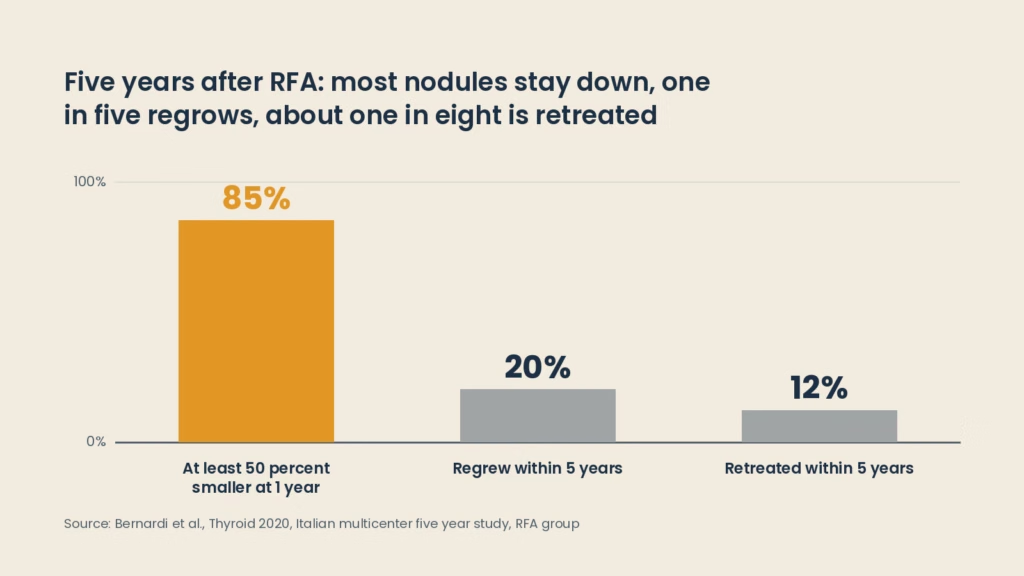
In the Italian multicenter study that followed 406 patients for five years after RFA or laser ablation, 20 percent of the RFA group regrew and 12 percent were retreated.
A quiet nodule that is not bothering you can be watched with a yearly ultrasound and thyroid function tests. Surgery is the answer when minimally invasive treatment does not get the result you need, or when a biopsy suggests cancer. It is one and done, typically day surgery, but some people need thyroid hormone every day afterward, so I try the minimally invasive options first.
The takeaway
Get the Doppler, bring the scans from before and after the ablation, and ask what the blood flow shows. Regrowth is a finding, and it deserves a proper reading.
Frequently asked questions
How big a nodule can be treated in one session?
Nodules up to about three to three and a half centimeters can usually be treated in one session. Larger ones usually need more than one treatment anyway.
Does Medicare cover thyroid RFA?
Yes, since 1 January 2025, under CPT 60660, and 60661 when multiple nodules are treated. Other insurers increasingly follow, so ask yours whether 60660 is covered, even if you were told no last year.
Can a pill or supplement shrink a nodule?
No. There is no medication that shrinks a thyroid nodule. A small dose of thyroid hormone does not do it, and no supplement or diet does either.
What do you need for a second opinion?
The ultrasound images from before the ablation, the images after, and the current scan. From those I can usually tell whether the supply was treated or left for safety.
Watch the full video. Shrinking a Thyroid Nodule Without Surgery: RFA in 2 Minutes
Also watch. Your Thyroid Nodule Grew: When It Is Fine and When We Re-Biopsy
Want someone to actually look? Book a visit with the Advanced Institute for Diabetes and Endocrinology: in person in Mansfield, Texas, for Dallas Fort Worth, or by video in Texas, Oklahoma, New Mexico, Colorado, California, Oregon and Washington. Call or text (817) 380-4880, or book at aidendo.com/contact.
Drop your questions in the YouTube comments. We read every one.
Last updated 16 November 2026. This article is general education, not medical advice.