
By Lindsey VanDyke, DO, Board Certified in Internal Medicine and Endocrinology
The scale is moving the way you hoped, and now there is hair in the shower drain, on your brush and on your pillow. You are doing what you were told, and it is still happening.
That is GLP-1 hair loss. It is real and common, and the medication is not poisoning your follicles. Your brain is making a decision, and hair is the first thing it cuts.
On 22 October 2026 I taught a room of electrologists in Washington, DC, and near the end a hand went up with this exact question. I answered it live in the Q&A on YouTube.
Does a GLP-1 cause hair loss?
Hair loss can follow a GLP-1, but the drug leaves the follicle alone. Significant weight loss from any cause sets off the same response in the brain, and hair is one of the first things it switches off.
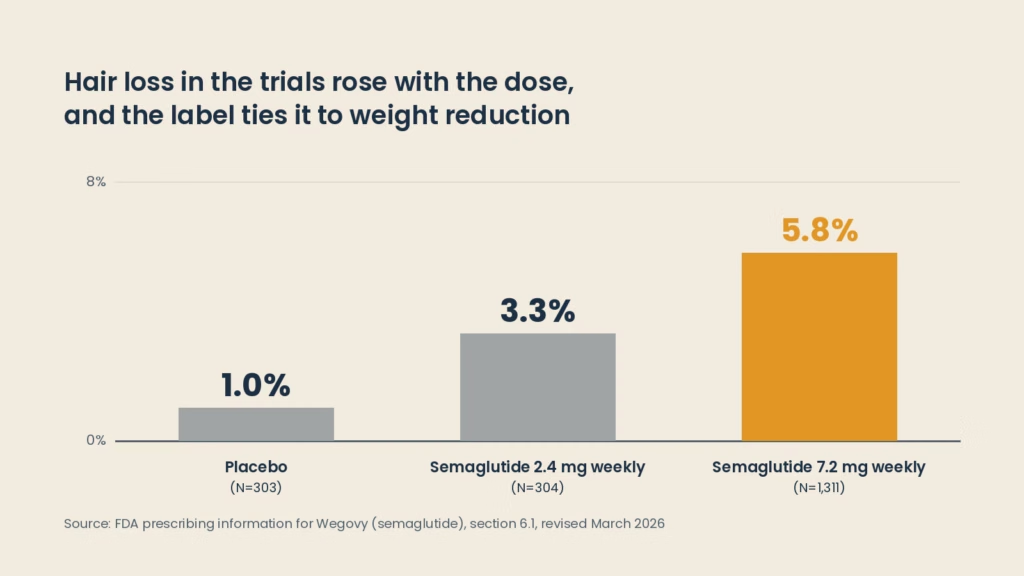
It looks the same after bariatric surgery or a crash diet, because the hindbrain is not reading the label on the pen. Switching pens does not fix it. The FDA label for Wegovy says hair loss was “associated with weight reduction”, reported in 3.3 percent of patients on semaglutide 2.4 mg against 1 percent on placebo. Zepbound reads the same way, at 4 to 5 percent on tirzepatide against 1 percent on placebo.
Why does your brain turn hair off when you lose weight?
Your brain turns hair off because it reads significant weight loss as a famine. The part that regulates metabolic balance sits in the hindbrain, the most primitive part, and it is very sensitive but not very smart.
“When you experience significant weight loss, your brain goes into panic mode, because it does not know you are doing this on purpose.” (from the video)
As far as it knows, you are about to die in a famine on the high desert 100,000 years ago. The triggers I named on stage are a loss of about 20 pounds, nutritional deficiency and losing weight too fast. Hair is not essential to survival, so it goes early. It is the same brain that unloads muscle on a GLP-1.
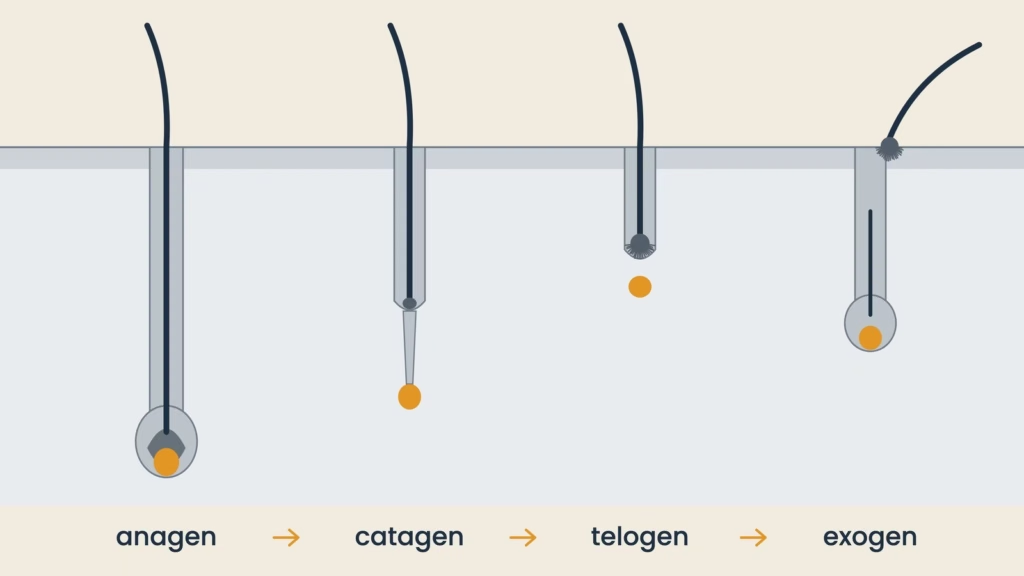
The timing throws people off. At any moment 85 to 99 percent of your hairs are growing, and between 1 and 15 percent are resting, in a phase called telogen. Weight loss pushes more follicles into rest, and the hair leaves later, in active shedding. By the time you count hairs in the comb, the decision was made some time ago.
What should I check if my hair is falling out on a GLP-1?
Start with how fast the weight is coming off, what you are actually eating and whether your strength is slipping. Then ask your prescriber whether the dose can come down.
If you feel no hunger at all and the idea of feeling any distresses you, I hear a problem. Under-eating gives the brain a second alarm on top of the weight loss. Hair and muscle go on the same signal, so watch for the three signs you are losing muscle.
The exercise floor I gave the room is 150 minutes of moderate intensity exercise a week plus strength training two to three times a week.
Why does GLP-1 hair loss get missed or made worse?
It gets made worse when nobody is supervising. Online GLP-1 mills send the medication after a form, patients who want zero hunger under-eat, and then someone hands them minoxidil and a multivitamin. The cycle repeats.
Grey market peptides are worse, because nobody knows where the product comes from or what is in it. Supervision is a conversation, and a form is not one, which is why I wrote about what we check before anyone gets a weight loss prescription.
For scale, a 2021 meta-analysis of 18 studies and 2,538 bariatric patients found hair loss in 57 percent, falling to 35 percent at 12 months or more of follow-up.
What actually helps GLP-1 hair loss?
What helps is fixing the famine signal: a slower pace, better nutrition, strength training and a dose that can come down under supervision. Minoxidil might come after that.
When the crown still needs help, minoxidil can regrow it, and the dose is fractional. I prescribe the smallest tablet, 2.5 milligrams, and have patients start by cutting it into quarters. I typically never give more than half a tablet because of low blood pressure and unwanted facial hair growth, and I watch blood pressure. You hate to give a medicine to treat a side effect of another medicine, so it is not my first move.
Will hair loss after weight loss grow back?
Not always, and I will not promise that it will. When the crisis signal eases, resting follicles are free to cycle back into growth, but whether every one does is a question I would send to dermatology.
You cannot fully prevent the panic response when you are losing 30, 50, 80 or 100 pounds. Asked whether the hair always comes back, I said:
“Are you always going to be able to reverse the hair loss? I would think not, and that may be a better question for dermatology.” (from the video)
The takeaway
You cannot stop the hindbrain from noticing a big weight loss. What you can control is the pace, the nutrition, the dose and the muscle, and those are what change what your hair does. Bring the whole picture to your prescriber, not just the hair.
Frequently asked questions
How long after starting a GLP-1 does shedding begin?
Shedding tends to show up two to three months after the trigger, which is why it never lines up neatly with the day you started or the number on the scale.
Will minoxidil make me grow hair on my face?
At the doses I use I do not see that problem, because the dose for crown growth is so small. The thing I watch is blood pressure.
Is hair loss a sign I am losing muscle too?
It can be. Both are outputs of the same famine signal, so if hair is coming out I ask whether strength is going backwards as well.
What does a GLP-1 visit with you cost?
A new consultation is $400, including the first follow up, and a follow up visit is $275. Traditional Medicare is accepted and a superbill is provided.
Watch the full video. Pellets, Bioidentical HRT and GLP-1 Hair Loss: 25 Answers
Want someone to actually look? Book a visit with the Advanced Institute for Diabetes and Endocrinology: in person in Mansfield, Texas, for Dallas Fort Worth, or by video in Texas, Oklahoma, New Mexico, Colorado, California, Oregon and Washington. Call or text (817) 380-4880, or book at aidendo.com/contact.
Drop your questions in the YouTube comments. We read every one.
Last updated 16 November 2026. This article is general education, not medical advice.