
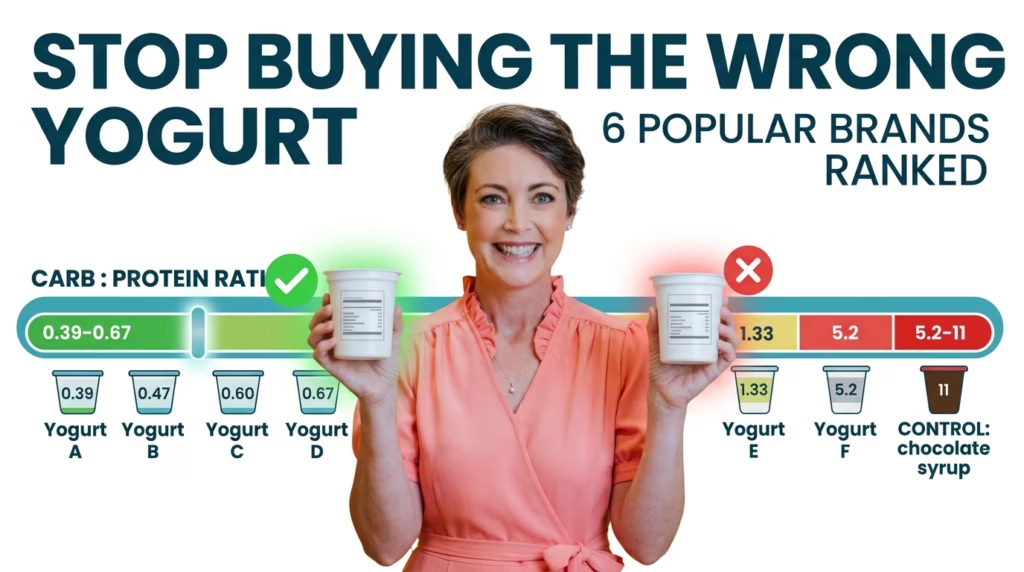
Yogurt is one of the most aggressively marketed “healthy” foods in the grocery store. The packaging tells you it’s good for you. The aisle placement tells you it’s good for you. The brand name often has the word “light” or “fit” or “Greek” right there on the label.
But some of these yogurts are functionally a pudding. They are dessert in a snack-sized cup, and your blood sugar treats them exactly that way.
So I went to the grocery store, picked six different yogurts across different brands and flavors, and ran them through the same test I teach my patients to run on every food they eat. I’ll walk you through every result, including a control I added that might surprise you.
What is the carb-to-protein ratio and why does it matter?
This is the single most useful number you can pull off a nutrition label, and almost nobody talks about it.
The carb-to-protein ratio tells you how smoothly your body will absorb the carbohydrates in a food. The smaller the ratio, the slower and more controlled the absorption. The more controlled the absorption, the more stable your blood sugar stays.
The ideal target ratio is about 1. That means roughly equal grams of carbohydrate and protein. When the ratio sits around 1 or below, I can feel pretty confident a patient’s continuous glucose monitor (a Dexcom or a Libre) isn’t going to go wild and crazy after they eat the food.
When the ratio climbs above 1, the food is going to behave more like a sugar delivery system, regardless of what the front of the package says.
Why did I use Hershey’s syrup as a control?
Because every good comparison needs a control, and I wanted something that nobody would mistake for health food.
Hershey’s syrup has a carb-to-protein ratio of 11. That’s the dessert benchmark. Hold that number in your mind as we go through the yogurts, because some of them are going to land closer to that benchmark than the marketing on the label would ever suggest.
Yogurt #1: Yoplait original strawberry
This is the classic. The yogurt your mom packed in your lunch.
I flipped the container around and the serving size is the full cup. In that cup, you get 140 calories, 26 grams of carbohydrate, and 5 grams of protein.
Carb-to-protein ratio: 5.2.
That is less than half the Hershey’s syrup ratio, but it’s still firmly in dessert territory. If you’re going to eat this, you have to pair it with something that slows the absorption down. Add a hard-boiled egg on the side. A handful of almonds. Some fiber. Without that buffer, your blood sugar is taking a ride.
This is not a snack you eat alone if you care about glucose stability.
Yogurt #2: Dannon Light & Fit toasted marshmallow
I’ll be honest, I’m not sure how I feel about a yogurt that’s flavored like toasted marshmallow. The American instinct to make every food taste like dessert is a separate conversation.
But the numbers tell a different story than the flavor name suggests. Serving size is the full container. 80 calories. 8 grams of carbohydrate. 12 grams of protein.
Carb-to-protein ratio: 0.67.
This one is great. You should not expect any meaningful blood sugar swing from this. On a CGM tracing, you’d see flat lines or barely a ripple. For a patient who needs something sweet but cannot afford a glucose spike, this is a smart choice. The marketing didn’t promise this and the flavor name actively hides it, which is exactly why reading the label matters.
Yogurt #3: Chobani black cherry on the bottom
Greek yogurt with fruit on the bottom. This is a good moment to teach a trick I share with my patients all the time.
When the fruit is on the bottom of a yogurt cup, do not stir it in. The yogurt sitting on top of the fruit will already have absorbed some of the flavor, and if you skim only the yogurt off the top and leave the fruit syrup at the bottom alone, you will save yourself a significant chunk of carbohydrates.
The numbers as listed: 110 calories, 16 grams of carbohydrate, 12 grams of protein.
Carb-to-protein ratio: 1.33.
That’s a solid number on its own. But if you use the fruit-on-the-bottom strategy and skip the syrup, you’ll come in at a ratio of 1 or below. Easy adjustment, real impact.
Yogurt #4: Oikos Triple Zero strawberry
Now we’re getting into the high performers. Greek yogurt, marketed as no added sugar, no artificial sweeteners, no fat.
The label: one container, 90 calories, 7 grams of carbohydrate (the lowest of any yogurt I tested), and 15 grams of protein.
Carb-to-protein ratio: 0.47.
Spectacular. This is exactly what you want from a snack that needs to do real work for you. High protein, low carbohydrate, and just enough sweetness to feel like a treat. If you’re trying to hit a protein target without adding a glucose load, this is one of the best grab-and-go options on the shelf.
Yogurt #5: Chobani Zero Sugar drinkable
This one straddles the line between yogurt and protein shake. It’s drinkable, more liquid than spoonable, but it lives in the yogurt section.
Serving size is the full 7-ounce bottle. 120 calories, 9 grams of carbohydrate, 15 grams of protein.
Carb-to-protein ratio: 0.6.
Another excellent choice. If you have a busy morning and need something fast that won’t tank your blood sugar mid-meeting, this is a strong option.
Yogurt #6: Oikos Pro Fusion strawberry
Also more of a drinkable than a traditional yogurt. The whole bottle is 7 ounces. 130 calories, 9 grams of carbohydrate, and a massive 23 grams of protein.
Carb-to-protein ratio: 0.39.
This is the winner of the whole lineup. Hands down the best ratio of the six.
So what is the final ranking?
Here’s how the six yogurts shake out, from best ratio to worst, with the Hershey’s syrup control included so you can see the spread.
Oikos Pro Fusion strawberry: 0.39 Oikos Triple Zero strawberry: 0.47 Chobani Zero Sugar drinkable: 0.6 Dannon Light & Fit toasted marshmallow: 0.67 Chobani black cherry on the bottom: 1.33 Yoplait original strawberry: 5.2 Hershey’s syrup (control): 11
The Yoplait, despite being the original “healthy” yogurt of an entire generation, is closer to chocolate syrup than it is to most of the other yogurts on this list. That should tell you something about how much grocery store marketing has shifted in the last twenty years, and how much it hasn’t.
What if my favorite yogurt has a bad ratio? Do I have to give it up?
No. You just have to be smart about how you eat it.
If a food doesn’t have the ratio you want, you have options. Don’t eat the full serving. Pair it with a different protein source on the side, like a hard-boiled egg, cottage cheese, or a small handful of nuts. Add fiber, like berries or chia seeds. Add a healthy fat, like avocado or nut butter. All of these slow carbohydrate absorption and flatten the blood sugar response.
The yogurt itself is not the only variable. The whole snack is.
How do I actually know if a food works for my body?
This is the part most nutrition advice skips, and it’s the part that matters most.
Where is the proof? It’s in the pudding.
Real personal data beats every label, every blog, every ranking, including this one. If you wear a Dexcom or a Libre, eat the food and watch your tracing. If your number stays calm, the food works for your body. If your number spikes, you have data, and now you can adjust.
That feedback loop is how you build a sustainable, personalized way of eating. Not by following someone else’s rules, but by learning your own.
A note on transparency
I want to be clear. I do not make any money off any of the brands I named in this article. I am not a paid representative for any yogurt company. None of these companies sent me product, paid me, or asked me to feature them.
These are products I see in the grocery store. These are things my patients ask me about. These are choices that real people are trying to make as part of managing diabetes, prediabetes, weight loss, or just living a healthier life.
There are no kickbacks here. We’re just trying to make good choices.
Want help building a real eating strategy for your blood sugar?
If you’re tired of guessing what to eat, decoding nutrition labels alone, and getting different answers from every wellness account on the internet, this is the kind of work I do every day with my patients. Whether you have type 2 diabetes, prediabetes, PCOS, are on a GLP-1, or just want to feel better in your body, we’ll build a strategy that fits your actual life.
📲 817-380-4880 🌐 aidendo.com
Telehealth available in Texas, California, Colorado, Oregon, Washington, Oklahoma, and New Mexico. We are actively expanding into more states.
In-person at our Mansfield, TX clinic, serving the DFW Metroplex.
New patients typically seen within two weeks.
Dr. Lindsey VanDyke, DO, FACOI, FEAA Board-Certified Endocrinologist Advanced Institute for Diabetes & Endocrinology