
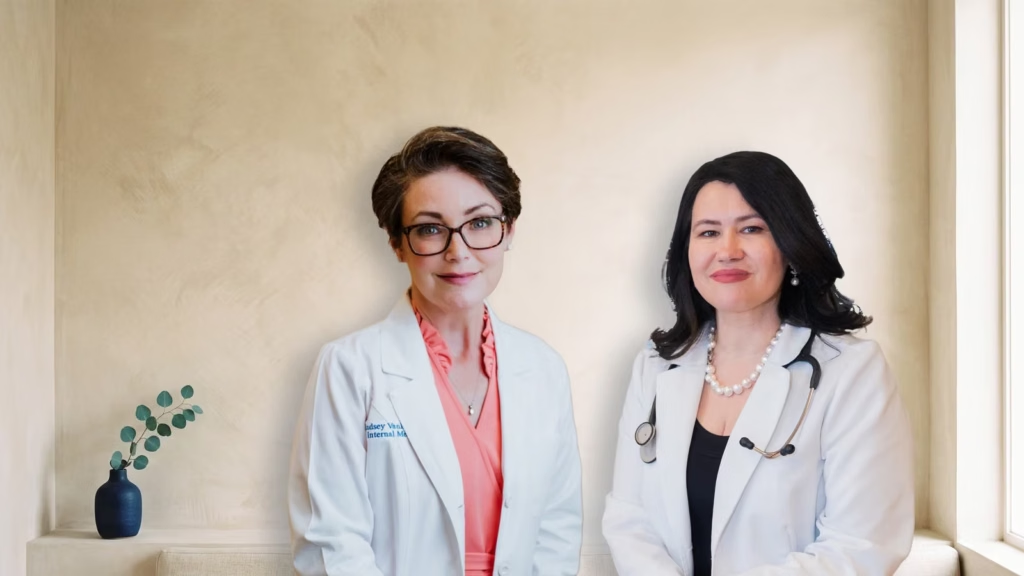
Last week I sat down with Dr. Diana Girnita, MD, PhD, FACR, a rheumatologist and host of the podcast Thriving with Arthritis and Autoimmune Diseases. Her patients have lupus, rheumatoid arthritis and Sjögren’s. Mine have Hashimoto’s, diabetes, and the hormone changes of midlife. The same women walk through both of our doors, and they arrive with the same questions, usually from social media: do GLP-1s cause thyroid cancer, what does a positive antibody mean, and what happens to all of this at menopause. So we answered them, as an endocrinologist and a rheumatologist comparing notes. The full episode is here; below is what I told her, and what I tell my patients.
Key takeaways
- The GLP-1 thyroid cancer warning refers to medullary thyroid cancer, 1 to 10 percent of all thyroid cancers, and came from rat studies at doses far above what people take. In two decades of human use there has been no signal.
- If you had papillary thyroid cancer and were told you can never take a GLP-1, that is false.
- Between 30 and 40 percent of Americans carry TPO antibodies, most without knowing. A positive test means autoimmune thyroiditis is present, not that it requires treatment today.
- Subclinical hypothyroidism, a TSH between about 5 and 10 with no symptoms, is watched rather than treated. Symptoms change the answer. A TSH of 10 is treated, full stop.
- The one supplement with evidence for the symptoms that travel with Hashimoto’s is selenium, and the dose is one Brazil nut a day.
- Women carry most autoimmune thyroid disease, and it clusters in two windows: the childbearing years and the menopause transition. After surgical menopause, thyroid hormone demand can fall by half.
- Estrogen-only therapy is showing encouraging vascular and cognitive data, and a synergy between estradiol therapy and GLP-1s is plausible. The details decide it: which hormone, how much, for whom.
If this is the question you came in with, it is the one we answer in your first hour here. New patients are seen within two weeks and you do not need a referral. Call or text (817) 380-4880.
Do GLP-1s cause thyroid cancer?
No human case of thyroid cancer has been attributed to a GLP-1 in roughly twenty years of use. The black box warning on this class of drug refers to one specific type, medullary thyroid cancer, which is 1 to 10 percent of all thyroid cancers. It came from animal studies in which rats received far larger doses than we give people, and rats have a different kind of cellular metabolism in the C-cells of the thyroid. Those rats got that cancer. People are different, and we do not see the signal in humans.
The warning has been on the label since the very first drug in the class. That is a long time to watch for something that has not appeared.
I had thyroid cancer. Can I take a GLP-1?
If it was papillary thyroid cancer, which is a distinctly different disease from medullary, then yes. I want to be very clear about this, because it happens constantly: someone who had papillary thyroid cancer is told they are never allowed a GLP-1 again, sometimes by their oncologist. That is false. There is no signal at all, in animal studies or in humans, between papillary thyroid cancer and the use of these medicines.
I had a total thyroidectomy for thyroid cancer at 21. I take this question personally.
Dr. Girnita asked: what does a positive TPO antibody actually mean?
A positive TPO antibody means autoimmune thyroiditis is present. It does not mean it has done anything meaningful yet, and it does not mean you need treatment today. Somewhere between 30 and 40 percent of the American population is walking around with positive TPO antibodies, most without knowing. The antibody predicts hypothyroidism, because Hashimoto’s is the most common cause of it, but it cannot tell us when, or how severe.
Some people carry the antibody for years and gradually need 25 or 50 micrograms of thyroid hormone. Others lose thyroid function entirely and need full replacement. Many never need anything. The antibody is a reason to watch, not a reason to treat.
One more thing I tell every patient with a positive TPO: autoimmune “birds of a feather flock together.” It may not show up in my specialty. It may show up in Dr. Girnita’s.
Why do women get more autoimmune thyroid disease, and what does menopause do to it?
Women are by far more likely to develop thyroid disease, and autoimmune thyroid disease in particular. Dr. Girnita offered two theories from the rheumatology side: the two X chromosomes doubling the genetic exposure, and estrogen, since autoimmune disease in women clusters in two windows, the childbearing years when estrogen is highest and the menopause transition when it drops abruptly. My own practice skews postmenopausal, so I see the second window every day.
Menopause also changes the thyroid conversation directly. If your estrogen drops abruptly, after surgery that removes the ovaries for instance, your thyroid hormone demand may fall by half. For a woman on levothyroxine that is a dose conversation, not a problem, but it has to be had. It is one of the reasons women’s hormones belong with an endocrinologist, who is watching the thyroid, the ovaries, the pituitary and the pancreas as one system, rather than one organ at a time.
Subclinical hypothyroidism: when I treat and when I watch
Subclinical hypothyroidism means your TSH has started to rise, somewhere in the gray zone between about 5 and 10, but you have no symptoms. Biochemically the conversation between your pituitary and your thyroid has been upset. Clinically, nothing is evident yet. In that situation we leave you alone and watch you a little closer.
If you are in the gray zone and you feel bad, tired, gaining weight, constipated, cold all the time, puffiness around the eyes, we give you a small amount of thyroid hormone and see if you feel better. If your TSH reaches 10, that is a slam dunk and we treat. I go through the whole decision in more detail in when I treat and when I watch.
Dr. Girnita asked: does a gluten-free diet or a supplement protocol help Hashimoto’s?
There is no good evidence that a special diet or eliminating a macronutrient changes the course of your TPO antibodies or your thyroid disease. Some people without celiac disease genuinely do not tolerate gluten or certain carbohydrates, and they feel better without them, but that is not the same as changing the thyroid illness.
The one thing with some evidence is selenium, not for the course of the disease or how much hormone you will eventually need, but for the hard-to-describe cluster of symptoms that travels with autoimmune thyroiditis. The best way to get it is one Brazil nut a day. That is the dose. I would never want people spending half their income on supplements; the supplement and wellness industry is at least three times the size of Big Pharma and is not held to the same standards for purity, potency or proof. My patients come back with their bag of Brazil nuts and they are fine.
Do GLP-1s help Hashimoto’s or inflammation?
I am not aware of any signal that GLP-1s mitigate, prevent or correct autoimmune thyroiditis. What I do hear, anecdotally and routinely, is that patients who miss a dose for a week notice it: swelling, stiffness, discomfort, which resolves when they restart. Whether that is the fat loss or a separate mechanism, I do not know of a trial that has answered it.
What GLP-1s do have is clear evidence for reducing vascular events, especially stroke, in type 2 diabetes. That is why I am motivated to use them there, and it is not only because of the weight.
Will my levothyroxine dose change on a GLP-1?
Possibly, and not because of the drug. Your thyroid demand changes with your body. An ultramarathoner needs more hormone. A pregnant woman needs more. Someone acutely ill needs less. If you start a GLP-1 at a body mass index of 30 and lose 10 or 15 percent of your weight, you have less mass to maintain, and your thyroid hormone need tends to go down. We recheck and adjust.
One more wrinkle: menopause. If your estrogen drops abruptly, after surgery that removes the ovaries for instance, your thyroid demand may fall by half. That is a dose conversation, not a problem.
Dr. Girnita asked: is hormone replacement therapy plus a GLP-1 better than either alone?
I would want to read the citation, because the devil is in the details: which hormones, at what dose, in whom. What I can say is that the recent data on estradiol therapy, especially estradiol used alone, has gone from reassuring to encouraging, with vascular benefits and cognitive benefits down the road. A study published the week we recorded looked at brain autopsies of women who had been on estrogen alone against women on no estrogen or combination therapy, and found a 35 percent reduction in Alzheimer’s risk in the estrogen-only group. That is on the order of fracture reduction from osteoporosis drugs, or vascular event reduction from statins. Huge deal.
So I can easily see an effect that is close to synergistic between estradiol therapy and GLP-1 therapy in the right patient. The demand for hormone therapy has risen so fast that we now send orders for an estrogen patch and the pharmacy cannot fill it. Which hormone, how much, and whether you are a candidate at all is an endocrinology decision, made with your history in front of us.
Microdosing, super responders, and why the weight comes back
People ask me about microdosing GLP-1s and I am never sure what they mean: deliberately staying below the minimum starting dose, or simply never escalating from the starting dose? A small portion of patients are what I call “super responders”, who get the full effect at the tiniest dose, and we cannot predict who they will be. For everyone else, the goal they set usually needs the higher doses to reach.
And when the medicine stops, the weight comes back, for the same reason it came off slowly in the first place: the body defends what it weighs. The metabolic playing field is never level.
Where this leaves you
Four things from the hour. The GLP-1 cancer warning is about medullary thyroid cancer, from rats, with no human signal in twenty years, and papillary thyroid cancer in your past does not rule these medicines out. A positive TPO antibody is a reason to watch, not a reason to treat. Menopause changes thyroid demand and the hormone therapy evidence is moving in a direction that makes an endocrinologist’s view of the whole system more useful, not less. And the one supplement worth your money for Hashimoto’s symptoms costs about as much as a Brazil nut.
The full conversation, 47 minutes, is on Dr. Girnita’s channel: Do GLP-1s Cause Thyroid Cancer? Endocrinologist on Hashimoto’s, Weight Loss and Arthritis. Thank you, Dr. Girnita, for the invitation.
See your own numbers, not a guess. Positive antibodies, a gray-zone TSH, or a GLP-1 question nobody will answer straight: that is a first visit here. An hour, $400, includes the first follow-up, in person in Mansfield or by video in seven states. To book your consultation, call or text (817) 380-4880.
Frequently asked questions
Do GLP-1s cause thyroid cancer?
No human case has been attributed to them in about twenty years. The black box warning refers to medullary thyroid cancer, 1 to 10 percent of thyroid cancers, and comes from rat studies at doses far above human doses. There is no signal in people.
Can I take Ozempic or Mounjaro if I had papillary thyroid cancer?
Yes. Papillary thyroid cancer is a different disease from medullary. There is no signal between papillary thyroid cancer and GLP-1 use in animals or humans. Being told otherwise, even by an oncologist, is incorrect.
What does a positive TPO antibody mean?
Autoimmune thyroiditis is present. It does not mean it has done anything yet or that you need medication. It predicts hypothyroidism but cannot say when or how much. Watch it; do not panic over it.
Should subclinical hypothyroidism be treated?
Usually not. A TSH between about 5 and 10 with no symptoms is watched. With symptoms, a small dose is tried to see if they improve. A TSH of 10 is treated.
Does selenium help Hashimoto’s?
It has some evidence for the symptoms that travel with autoimmune thyroiditis, not for the course of the disease. The dose is one Brazil nut a day, not a bottle.
Will a GLP-1 change my levothyroxine dose?
It may, because losing weight lowers your thyroid demand. The same is true of menopause, pregnancy and illness in different directions. The dose is rechecked and adjusted.
Should I see an endocrinologist or a gynecologist for menopause?
If your symptoms involve the thyroid, weight, blood sugar or a GLP-1 alongside the hormone changes, an endocrinologist is watching all of those as one system. Thyroid demand can fall by half after surgical menopause, and that is an endocrine decision.
Who is Dr. Diana Girnita?
A rheumatologist, MD, PhD, FACR, and host of the podcast Thriving with Arthritis and Autoimmune Diseases, where this conversation was recorded on 9 October 2026.
Related reading
- Normal TSH but still exhausted: when subclinical hypothyroidism needs treatment
- Ozempic muscle loss: why your brain does it on purpose
- Thyroidectomy recovery: what it is actually like now
- Why blasting women with testosterone pellets is not safe
Dr. Lindsey M. VanDyke, DO, FACOI, FEAA, is dual board certified in internal medicine and in endocrinology, diabetes and metabolism. She founded the Advanced Institute for Diabetes and Endocrinology in Mansfield, Texas, where new patients are typically seen within two weeks. She had a total thyroidectomy for thyroid cancer at 21.
In person in Mansfield, or by video in Texas, Oklahoma, New Mexico, Colorado, California, Oregon and Washington.
Book your consultation. Call or text (817) 380-4880.